
Ireland kick off their Nations League campaign in just a month’s time, with Heimir Hallgrímsson finalising his strongest squad following his assessment of close to 70 players over the last year.
The Irish manager cast the net wide, as he did during his previous role with Jamaica, in an attempt to gauge the full potential of his player pool. A thorough overview of Ireland’s playing personnel like this has not been seen since Giovanni Trapattoni’s Portugal training camp in 2008.
Despite the plethora of players who have either been capped or simply joined up with the Irish camp over the last year, one position that may still be a cause for concern is right-back or right wing-back.
With Séamus Coleman still without a club and approaching his 38th birthday, the former captain and current first-choice option on the right is inevitably in need of a consistent deputy and, ultimately, a successor.
Established players such as Alan Browne and Jason Knight have deputised at right wing-back, with the latter putting in an accomplished display while captaining Ireland from the position against Grenada. Festy Ebosele appeared to be the obvious long-term successor, but fitness issues and club instability have made him an unreliable option. Jake O’Brien has also played at right-back for Everton in a back four, but Hallgrímsson sees him primarily as one of his starting central defenders in a back three.
Matt Doherty represents the most experienced alternative, but his performances for both club and country in recent years, coupled with the fact that he is now 34, make him a less attractive long-term solution.
Other untested options such as Josh Honohan of Lincoln City, Tunmise Sobowale of Shamrock Rovers and Danny McNamara of Charlton Athletic could come into contention, as could Irish-eligible Josh Key of Swansea City.
There could, however, be two more unconventional solutions to replacing Coleman — neither of whom would traditionally be considered a right-back or wing-back.
Chiedozie Ogbene
The first is fan favourite Chiedozie Ogbene, who has traditionally played in a more advanced position on the right for Ireland.
Ogbene possesses a terrifying ability to burst forward with his blistering pace, coupled with tremendous work rate and, importantly, a habit of popping up with goals in a variety of ways. However, his end product, quality of delivery and decision-making can sometimes let him down, particularly when he is asked to make the final pass or take advantage of opportunities in the final third.
That is where an argument could be made for moving him further back.
During his time at Rotherham United, Ogbene played in several positions, including centre-forward, but also spent time as a right wing-back. His pace and power when attacking from deep caused problems for opposition defences, while his ability to cover huge amounts of ground allowed him to transition quickly between defence and attack.
That experience should not be underestimated.
Ogbene’s athleticism is already key to helping Ireland transition from defence into attack, while his tenacity and willingness to win the ball back could potentially make better use of his qualities in a deeper role. Rather than asking him to consistently unlock a defence in the final third, Ireland could use his pace to carry the ball forward from deeper positions and attack the space in front of him.
There would, of course, be risks.
Ogbene would need to improve his defensive positioning, delivery and decision-making, while playing as a wing-back would place greater demands on his discipline and tactical awareness.
But the raw ingredients are certainly there — and crucially, he has already demonstrated that he can operate in the position at club level.
For a player whose greatest strengths are his pace, physicality and work rate, Ogbene could potentially be better suited to the demands of a modern wing-back than those of an attacking winger, where his weaknesses in the final third can sometimes be exposed.
https://x.com/UEFAEURO/status/2042259026164043851?s=20
James Abankwah
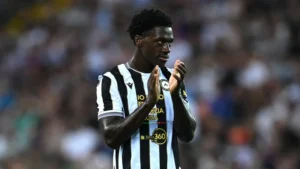
The other potential option is natural centre-back James Abankwah of Udinese.
Having burst onto the scene as a teenager with St Patrick’s Athletic, the Waterford-born defender produced a number of accomplished performances beyond his years, including a mammoth showing in the 2021 FAI Cup final victory over Bohemians at just 17.
Abankwah subsequently joined Udinese, spending loan spells with St Patrick’s, Charlton Athletic and Watford as he continued his development.
It was with Watford that Abankwah gained valuable experience at right-back, including in a back four.
Abankwah looks most comfortable centrally, but his physicality, aggression and ability to read the game lend themselves to operating in wider defensive areas. He has also shown that he is comfortable progressing the ball from defence, something that could become increasingly important for Ireland if Hallgrímsson continues to favour a system with three central defenders and attacking wing-backs.
Indeed, Abankwah has already acknowledged that adapting to the position is something he is actively working on. He has described himself as a natural centre-back but has spoken about learning the wing-back and right-back positions.
That adaptability could prove crucial.
His performances on the international stage have also demonstrated that he is comfortable defending in wide areas. His ability to deal with one-on-one situations, combined with his physicality and willingness to engage attackers, gives him the defensive tools required to operate on the flank.
At the other end of the pitch, his composure in possession and ability to carry the ball forward could allow him to develop into a more modern type of full-back.
His natural position may be centre-back, but that does not necessarily have to be a disadvantage.
If Ireland continue to use a back three, Abankwah could potentially operate as the more defensively-minded option on the right, providing greater security behind an attacking wing-back. Alternatively, his experience at right-back means he could eventually become an option in a traditional back four.
At just 22, there is also plenty of time for him to develop the positional and attacking elements of his game.
Two very different solutions
Both Ogbene and Abankwah provide viable alternatives at right-back or right wing-back, but in very different ways.
Ogbene would arguably suit Hallgrímsson’s preferred wing-back system. His pace, physicality and work rate could allow Ireland to turn defensive situations into attacking opportunities in an instant. He has already played the position successfully at club level and would offer a more immediate solution.
Abankwah, meanwhile, represents the longer-term option. At 22, he has considerably more room for development and already possesses many of the defensive attributes required to play the position. His natural position may be centre-back, but his experience at right-back and increasing exposure to wing-back could make him a fascinating option for Ireland over the coming years.
There is an intriguing contrast between the two.
Ogbene would be an attacking player being asked to become more defensively responsible.
Abankwah would be a defender being asked to become more comfortable going forward.
Neither player was developed as a traditional right-back.
But perhaps that is exactly why both are worth considering.
Séamus Coleman has set an incredibly high standard for what Ireland should expect from the position. His longevity, professionalism, defensive commitment and leadership will be extremely difficult to replace.
Finding another Séamus Coleman is probably unrealistic.
Instead, Ireland may need to find a different solution altogether.
Ogbene and Abankwah offer two very different answers to that problem. Ogbene could provide the explosiveness and attacking threat required by a modern wing-back, while Abankwah could offer the defensive security and versatility required from a player capable of operating in either a back four or back three.
Neither player is a traditional right-back.
But both have shown that they can play there.
And with Ireland searching for a long-term successor to one of the country’s greatest-ever right-backs, that versatility could ultimately prove more valuable than having a player who simply fits the position on paper.


