The first game in a Nations League campaign which is unfortunately marred by things much more important than football kicks off in Kosovo’s capital city of Pristina on Thursday night. The Republic of Ireland have never met their hosts in a senior international game before, with the Kosovars only making their competitive bow away to Finland in September 2016. Irish fans can be forgiven, therefore, for knowing little about their upcoming opponents, who punched well above their weight in recent times, only missing out on the 2026 World Cup thanks to a 0-1 defeat to Turkiye in March.
The journey to that play-off final defeat in the Fadil Vokrri Stadium is the foundation for this article, as Franco Foda’s men impressed on their way to a second-placed finish behind Switzerland, who had a 111 year headstart on the international stage. Apart from a 4-0 opening day defeat in Basel, Kosovo went the rest of the campaign unbeaten, keeping four clean sheets along the way.
How do they play?
In possession, Kosovo are a direct, vertical side who like to attack the spaces quickly. Statistically, they were 40th out of 54 European nations in the World Cup Qualifiers for accurate passes per match. You won’t see long, slick passing strings watching this team, they want to waste no time getting the ball to the final third. They’ll do this by using deep runs, double movements and direct balls to 6’4″ talisman and captain Vedat Muriqi. The Fenerbache man no doubt being a key reason behind their 25 accurate long balls per game in the last campaign, the 12th best in Europe.
They are also a very transitional side, and will look to be ruthless in the counter attack, desperately trying to fashion chances against disorganised defences. The Swedes know this better than anyone- in two first half moments last September they went from attacking to conceding in the blink of an eye.
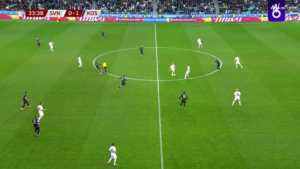
Their transitional qualities are helped by an excellent ability to win the second ball and counter press effectively. In the 34th minute of their 2-0 win in Slovenia last November a hooked clearance from right centre-back Dellova led to a contested ball. When it dropped to the Slovenian player, he was swarmed by players in black, each one determined to come out on top in this phase and launch an attack. The Irish midfielders will no doubt be briefed about the battle in the middle of the park.
All this to say, how can Ireland look to curtail their threats and ask questions of their weaknesses?
In the early innings of their seven goal thriller against Slovakia in March, their opponents show the value of well-coached transition control, a crucial facet of their attack. As the ball breaks and Kosovo, wearing white, look to launch a counter-attack, notice Slovakia’s ability to delay and protect the centre, forcing their opponents to the other side of the pitch. Once they’ve done this and have adequate numbers behind the goal, watch how they begin pressing the receivers much more aggressively, eventually forcing them back to their goalkeeper, who opts to go long and turn it into a 50/50 higher up the pitch. They may have 6’4″ Muriqi, but we have 6’6″ O’Brien.
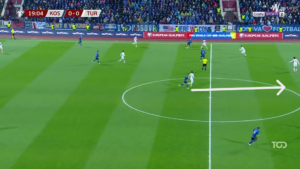
In the play-off final against Turkiye, as they look to make one of their trademark attacks, they expose a potential chink in their armour which Ireland may well look to take advantage of. A long ball is pumped towards Muriqi, who looks to play it to his strike partner, the oncoming Fisnik Asllani. The move is clearly preempted by midfielder Rubin Hodza, who gambles and looks to make a run from deep to exploit the space behind his opponent’s backline. Hoffenheim’s Asllani, however, loses possession, and a gaping hole is left in the middle of the park. Can Ireland recognise and expose a moment like this?
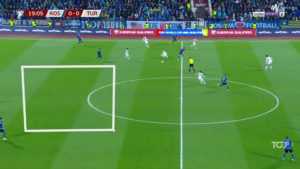
Out of possession, expect to watch a team who are happy to play without the ball for long periods, evidenced by their average of 40.2% possession in their last campaign. Right wing back Mergim Vojvoda drops back to form a five man defence from his more advanced position when they have the ball, while the midfielders and forwards will form a tight-knit unit to prevent central progression. In other words, a 5-3-2. In open play, they won’t press very high. Rather, they’ll wait until their opponent moves the ball towards the middle third before engaging.
Naturally, being a side that plays more transitionally, they will press high in more static phases of the game, such as short goal kicks, or free kicks and throw ins in the opposition third. Even then, on a few occasions they have looked unconvincing, such as in the below clip from the Slovenia game. Some look committed and willing to press high, while others are worried about whats going on behind them, making the press easy to break, eventually leading to a Slovenian throw deep in Kosovo’s third. Another potential area for Ireland to target.
It would be remiss of me not to mention set pieces in 2026, but apart from the goal fest against Slovakia, there isn’t much to write home about. Attacking wise they averaged 0.21 expected goals per game in their World Cup campaign from these phases. Conversely, around 0.26 expected goals against per game. There is obviously height in both packs, but Kosovo’s games, statistically at least, produced a little less attacking-wise and defensively than an average Premier League game.
This is a side who are clear in their identity and intentions both on and off the ball. The hope is that Ireland can begin this campaign by punishing their weaknesses and becoming much more clear in their own characteristics as the road to Euro 2028 begins.
Footage taken from Bein Sports and Fubo Sports.